
By: Olivia Hollenbach
Background
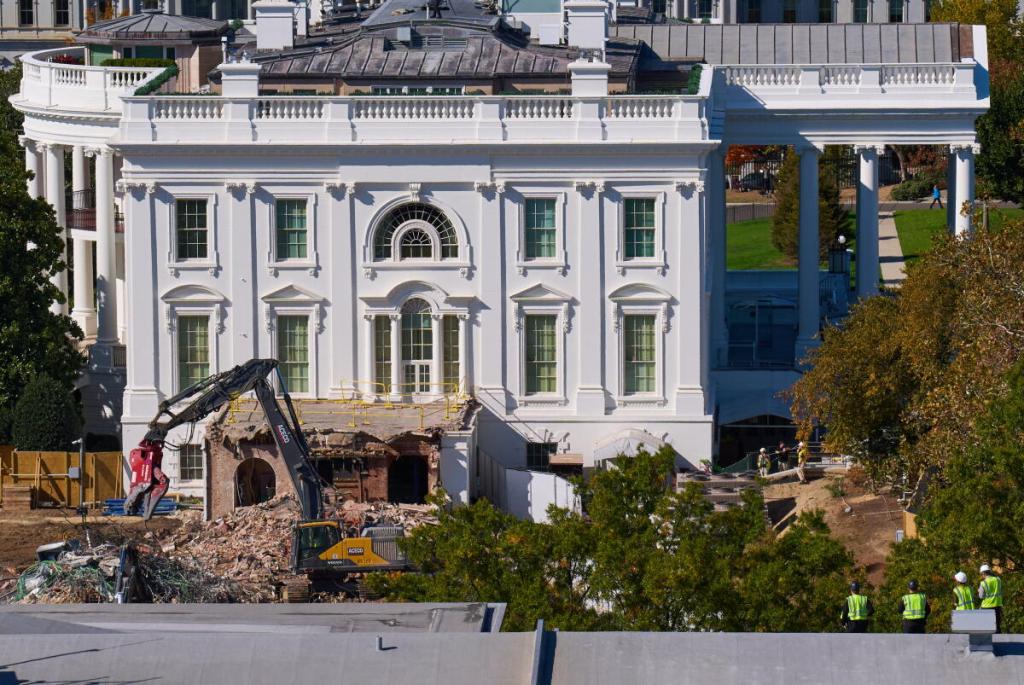
On October 20th, 2025, the White House changed. The East Wing, home to the office of The First Lady, was demolished to make way for a new 90,000 square foot ballroom. On December 12 of the same year, the National Trust for Historic Preservationfiled a suit in US District Court for the District of Columbia on the construction of the ballroom. They sought an injunction on construction until the government went through all the steps of the mandated review process. Claims within the suit include failure to comply with the National Capital Planning Act, failure to comply with the Environmental Policy Act, lack of congressional approval, and violating the Property Clause of the Constitution.
On March 31, 2026, U.S. District Judge Richard J. Leon grantedThe National Trusts motion for a preliminary injunction. The injunction was set to go into place on August 21. The U.S. Government appealed this decision and on August 7, 2026, the U.S. Court of Appeals for the District of Columbia upheld the injunction and held that President Trump cannot build the ballroom without Congressional approval, in a 2-1 decision. The dissent, written by Circuit Judge Rao, noted that she thought that there was a standing issue.
SCOTUS Decision
Again, the government appealed, this time to the Supreme Court requesting a stay. Chief Justice Roberts issued an administrative stay. This put a hold on the lower courts order and gave the Supreme Court more time to consider the appeal. In a Per Curiam decision, The Court granted the stay. Without deciding if the project was legal, The Court allowed construction of the ballroom, citing a standing issue.
Standing
As you may remember from Con Law, standing requires three things. It requires an injury in fact, traceability, and redressability. The Court rests it decision in National Park Service v. National Trust for Historic Preservation on the injury prong. Within the injury prong, we must address the 2-step test. For there to be injury-in-fact, the injury must be concrete and particularized and actual or imminent, as set out in cases such as Lujan v. Defenders of Wildlife.
The appellees in this case rest their standing on the “aesthetic, cultural, and historical” interests of Alison Hoagland, a member of the National Trust for Historic Preservation, who lives in Washington D.C. and visits the neighborhood around the White House monthly. The Court did not find this compelling. The court held that offense, disagreement, and distaste do not qualify as concrete or particularized injuries.
The Court worried that if they accepted the Trust’s standing analysis there would be a slippery slope where virtually any government action that a citizen disagreed with could be challenged.
The question that arises is what will happen to aesthetic injury?In the past The Court has ruled that aesthetic injury is enough for standing. In Japan Whaling Association v. American Cetacean Society, The Court held that the adverse effect on whale watching was enough to meet the standing requirement. In Lujan, Justice Scalia said, “of course, the desire to use or observe an animal species, even for purely esthetic purposes, is undeniably a cognizable interest for purpose of standing.” In Friends of the Earth, Inc. v. Laidlaw aesthetic injury without any actual proof of environmental harm met the standing requirement. Finally, in Summers v. Earth Island Institute, Justice Scalia reaffirmed that a “mere esthetic interests of the plaintiff,” are enough to support standing.
The Court in National Trust attempted to say that the claims of “offense, disagreement, or distaste” is the basis of the complaint. Chemerinsky, Dean of UC Berkley Law, notes that offense, disagreement, and distaste are “the essence of an aesthetic injury,” which The Court continues to say is an acceptable basis for standing. The Court is saying that you need more than a mere offense but is giving no indication as to what more is.
This decision is creating an undefined hole in the standing law and disrupts fifty years of precedent. Time will tell if aesthetic injury alone remains enough for standing.
Future of 1600 Pennsylvania Avenue
With the Supreme Court undoing the injunction placed on the construction by the Court of Appeals DC Circuit, construction ofthe ballroom will continue. In a statement on Truth Social, President Trump expressed his pleasure in the decision of The Court and that the ballroom construction will go on uninterrupted. Additionally, the Trump Administration gave Americans insight on the construction timeline. It appears that the project is nearing the halfway point, with hundreds of workers spending “20 hours a day, 7 days a week to keep the project ahead of schedule and under budget.” Completion is expected in August of 2028.
The Washington D.C. skyline is changing, and the justiciability requirements might be to.

 Open Bench