
“More than 22,000 looted artifacts from across the world seized by Homeland Security“.
By: Olivia Hollenbach
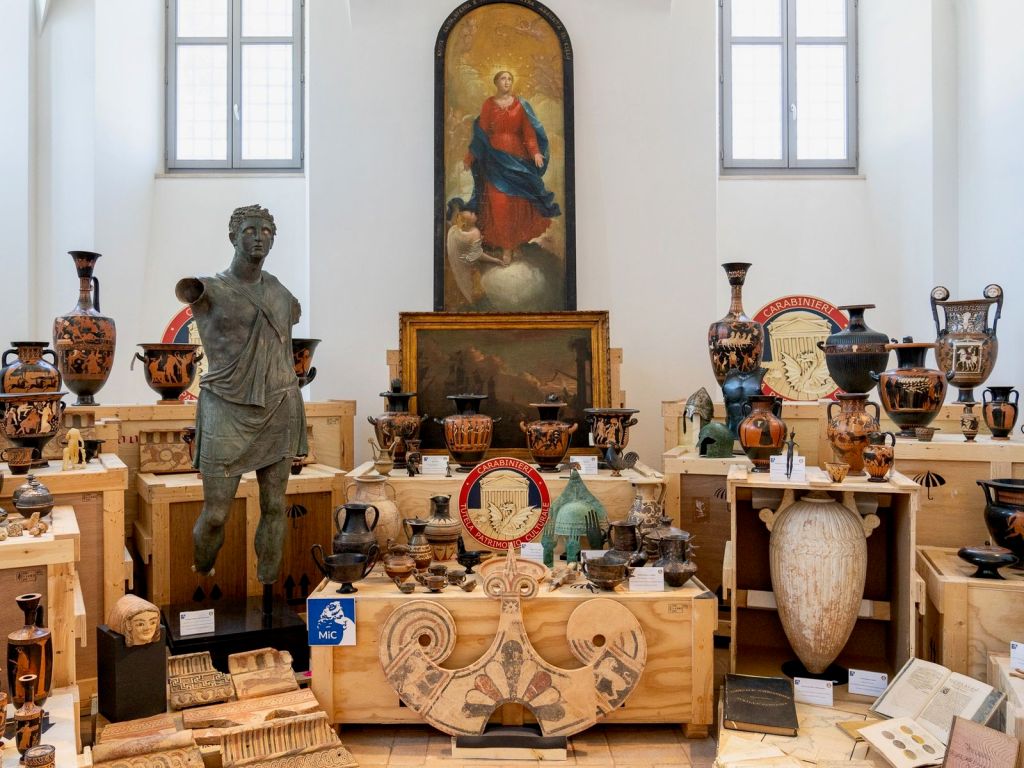
On Friday August 28th, 2026, in Tampa, Florida, U.S. Immigration and Customs Enforcement’s (ICE) Homeland Securities Investigation (HSI) team in conjunction with HSI’s Cultural Property, Art and Antiquities Division and U.S. Customs and Border Protection (CBP) announced the seizure of over 22,000 smuggled artifacts. This seizure marks one of the largest in HSI’s history.
The Facts
The items seized include ancient artifacts from around the world. These objects, some dating back 5,000 years, include vases, weapons, jewelry, and mosaic picture frames, according to ICE. Among the artifacts, there are Egyptian statues, Byzantine glass vessels, and Greek and Roman coins. According to the statement by HSI, the preliminary evaluations of the artifacts show that some objects are from ancient cultures dating between 1,000 and 5,000 years ago and come from sites across the world, including Europe, Africa, and the Eastern Mediterranean.
The formal identification of all the objects will take time. The agency will work with official and universities, including the University of South Florida and the University of Pennsylvania, to identify and authenticate the artifacts. This is a prolonged process as there is no field tests to identify the objects, like there are with narcotics.
The Law
HSI’s Cultural Property, Art and Antiquities Program targets criminal networks that are involved in theft, smuggling, and the sale of looted or stolen artifacts. The team is able to target these networks through a series of U.S. laws intended to protect antiquities. One of these laws is the National Stolen Property Act (NSPA). NSPA makes it illegal to transport any stolen artifact over $5,000 across states lines. NPSA also does not apply to museum collections that have been illegally obtained, only to privately held stolen goods. AlthoughHSI has not announced the charged filed, it is likely that this will be some of the charges faced in Florida. According to Derek Fincham, professor of law at South Texas College of Law Houston, the current prevailing regulatory response to looting is the seizure of the looted goods, which was seen in the Florida case. Fincham argues that there must be increased criminal liability for traffickers and more resources related to prosecuting traffickers.
The trafficking of cultural property comes with relatively low risks compared to other trafficking activity, such as narcotics. In addition to its low risk, there is a large market and illicit structure for the trafficking and smuggling of cultural property, art, and antiquities. This lucrative market helps to fund other criminal enterprises, including terrorism. A perfect example of this is ISIS destroying and looting the robust cultural heritage of Syria.
What’s Next
HSI has two main goals in their investigations: stopping black-market trade in ancient artifacts and the repatriation of those artifacts.
The first goal can be met by a continued emphasis on seizure and arrests made to disrupt the market for looted antiquities. The second goal is often met following an HSI investigation. These investigations often lead to the repatriation of artifacts to their country of origin. Recently, HSI has repatriated stolen cultural property to Greece and a Picasso painting valued at $15 million. The repatriation of these 22,000 artifacts will be slow, as they first need to be authenticated and researchers by specialists, but HSI’s dedication to protecting cultural heritage should see many of these artifacts returned.

 Open Bench